TeamViewer Intelligence alternative: AI-powered remote support without the enterprise price tag
A practical comparison of TeamViewer Intelligence and DeskZap's AI for remote support — session summaries, analytics and an in-session assistant — for UK teams that want the same AI features at small-team pricing, with the option to keep data in their region.
Article menuOpenClose
- What TeamViewer Intelligence actually is
- The catch: enterprise pricing and cloud-only delivery
- What a real alternative needs to offer
- DeskZap's AI: the same three capabilities
- The real differentiator: your models, your region
- The in-session assistant, compared honestly
- How to evaluate the switch
- Who should consider the alternative
- TeamViewer Intelligence bundles AI session summaries, analytics and an in-session assistant (Tia) into its paid tiers — capable, but priced and licensed for enterprise and delivered cloud-only
- DeskZap offers the same class of AI — Session Insights, Session Analytics and a CoPilot assistant — from its Business plan, at UK small-team GBP pricing
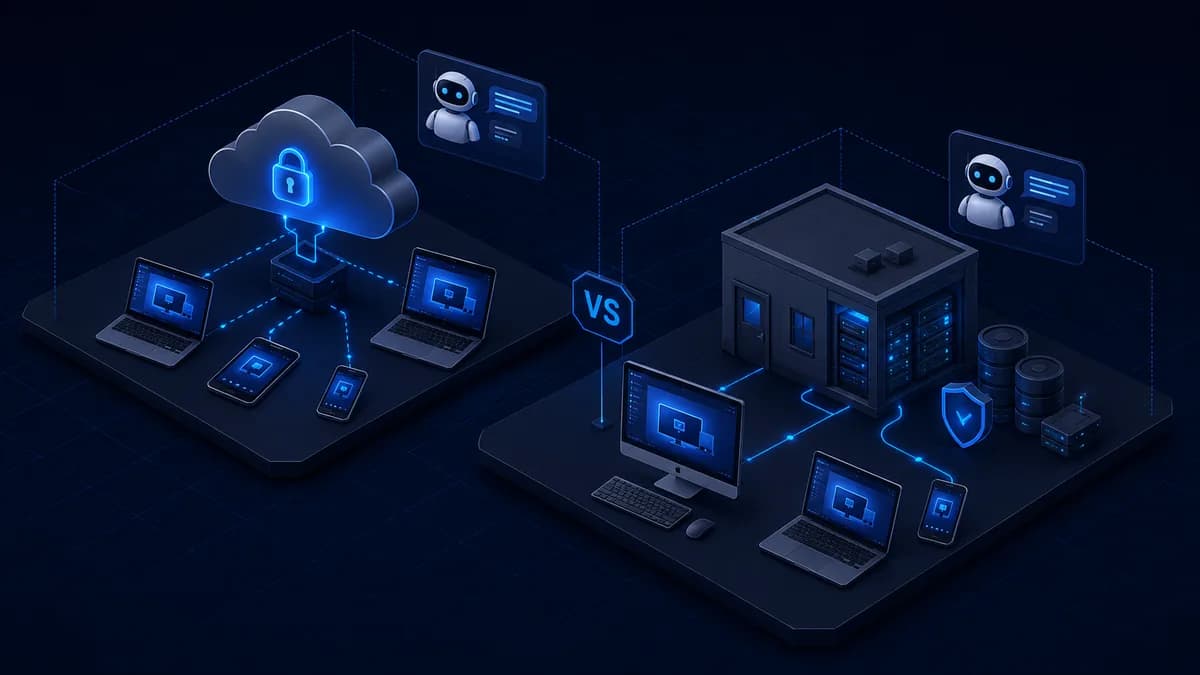
- The clearest differentiator is data control: DeskZap's AI can run on cost-effective or self-hosted models so session data stays in your region, which cloud-only suites cannot match
- For UK MSPs and small IT teams, the decision is rarely whether AI helps — it is whether you can get it without enterprise seat pricing and without shipping session data to a third-party cloud
What TeamViewer Intelligence actually is
TeamViewer Intelligence is TeamViewer's suite of AI features for remote support. In practice it covers three things: automatic session summaries that document each support case, analytics dashboards that surface patterns across sessions, and an in-session assistant — branded Tia — that a technician can ask for device diagnostics and suggested fixes during a live session.
It is genuinely useful technology, and it is fair to say the big incumbents have moved quickly here. So the honest question for a UK team is not whether TeamViewer's AI works — it does — but whether the commercial and technical model around it fits a small team or an MSP. That is where the alternative case is strongest.
The catch: enterprise pricing and cloud-only delivery
Two things tend to push smaller teams to look for an alternative. The first is price. TeamViewer's AI features are bundled into its paid tiers, but those tiers are priced and licensed for enterprise buyers, often with per-seat costs and renewal terms that feel heavy for a five-to-fifty-person team. You are frequently buying a lot of platform to get the AI.
The second is delivery. TeamViewer Intelligence is a cloud service: session content is processed in the vendor's cloud. For a UK business handling client data, that raises the same questions the ICO's cloud and AI guidance expects you to answer — what is processed, where, and on what basis. If your answer needs to be 'the data stays in our region, on infrastructure we control,' a cloud-only AI suite cannot give you that.
Neither point is a criticism of the technology. They are simply the reasons a smaller, data-conscious UK team starts comparing.
What a real alternative needs to offer
A credible TeamViewer Intelligence alternative has to clear three bars, not one. It needs the AI features themselves — summaries, analytics and an in-session assistant — or it is just a cheaper remote desktop tool. It needs pricing that suits a small team in GBP without enterprise procurement. And it needs a data story you can defend to a client or an auditor.
Meeting one of those is easy. Meeting all three is the actual test, because the affordable tools historically had no AI, and the AI-rich tools were priced for enterprise and locked to their cloud.
DeskZap's AI: the same three capabilities
DeskZap ships the same class of AI features, structured around the same jobs. Session Insights writes up each session automatically — issue, steps, resolution, smart tags — with a human verification step so only confirmed summaries become team knowledge. Session Analytics builds dashboards from those summaries: recurring issues, resolution times, volume and workload, with no separate reporting tool to configure.
The in-session assistant is CoPilot: a technician can ask it, inside a live session, for context and suggested fixes drawn from the team's own past resolved cases, and it cites where each answer comes from. It is the direct counterpart to TeamViewer's Tia.
The difference is the packaging. Insights and Analytics are included from the DeskZap Business plan, and CoPilot is an add-on on Advanced — at UK small-team pricing rather than enterprise seat rates.
The real differentiator: your models, your region
The feature comparison matters, but the sharpest difference is data control. DeskZap's AI is designed to be provider-flexible: it can run on cost-effective hosted models or on self-hosted models, which means session data can stay in your region instead of being shipped to a vendor's cloud. Cloud-only AI suites cannot offer that.
For a regulated UK business — legal, healthcare, finance — this is not a nice-to-have. The ICO's data security guidance expects appropriate technical measures based on risk, and the NCSC's cloud guidance frames data location and control as core considerations. Being able to say 'our support AI runs on infrastructure we control, in our jurisdiction' is a genuine procurement advantage, and it is exactly the option the incumbent cloud suites do not give you.
The in-session assistant, compared honestly
Both TeamViewer's Tia and DeskZap's CoPilot do the same core job: give a technician answers inside a live session, grounded in device context and past resolutions, so less experienced staff can work like your best people. Both are advisory — they suggest, the human decides.
The design principle worth holding either way is that a support assistant should propose, not act unsupervised. State-changing actions on a customer's machine should stay behind an explicit human approval, and access should remain tied to named operator accounts with strong authentication. An assistant that quietly executes changes is a liability, however clever it is. The value is in speeding up diagnosis and knowledge transfer, not in removing the technician.
How to evaluate the switch
Run the comparison on the three bars, not on a feature checklist. First, do you get summaries, analytics and an in-session assistant? Second, what does it cost for your actual team size in GBP, including renewals? Third, can the AI run where your data-protection posture needs it to — your region, ideally infrastructure you control?
Then test it on real work. Run a week of live sessions, verify the summaries, look at whether the analytics surface anything you did not already know, and ask the in-session assistant a few genuine problems. The wider TeamViewer alternative comparison covers the non-AI factors — unattended access, pricing model, self-hosting — that should also weigh in.
Who should consider the alternative
If you are an enterprise already standardised on TeamViewer with the budget and cloud posture to match, there is no urgency to move. The alternative case is strongest for UK MSPs, IT consultancies and small-to-mid IT teams who want the productivity of AI-assisted support but cannot justify enterprise seat pricing, and for any organisation whose data-protection requirements make cloud-only AI a hard sell.
For those teams, the pitch is simple: the same AI support features — automatic documentation, analytics and an in-session assistant — at small-team pricing, with the option to keep session data in your own region. You can see DeskZap's AI features here, and the plan they are included in on the pricing page.